
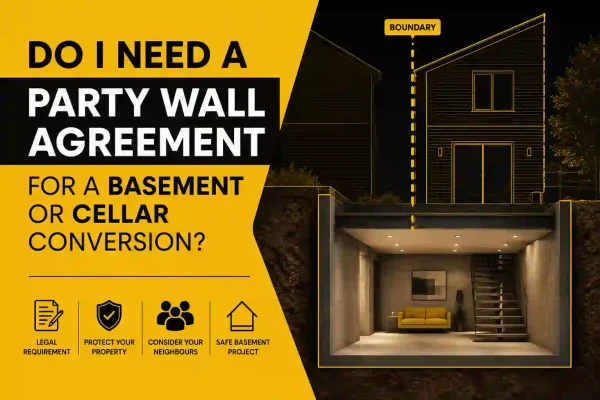
Basement and cellar conversions are becoming a popular choice for homeowners who want to make better use of the space they already have, without expanding the footprint of their property. Whether it’s a home office, gym, entertainment room, or an extra bedroom, transforming a basement can be a practical way to create more usable living space while also potentially increasing the value of the home.
However, many homeowners are surprised to learn that basement excavation works can have legal implications under the Party Wall etc. Act 1996. If your project involves digging near a neighbouring property or shared boundary, you may need a Party Wall Agreement before work can begin .
Understanding your obligations early can help you avoid costly delays, neighbour disputes, and potential legal action. Here’s what you need to know.
What Is a Party Wall Agreement and Why Does It Matter for Basement Cellar Conversions?
A Party Wall Agreement formally records the obligations and rights of neighbouring property owners when building work involves a shared wall or structure.
Basement and cellar conversions often involve excavation works that can impact the stability of nearby buildings. Because of this risk, the Party Wall Act requires property owners to notify affected neighbours before certain types of work commence. What Happens If You Start Work Without a Party Wall Notice?
The agreement helps protect both parties by documenting the condition of neighbouring properties and outlining how the work should be carried out safely.

When Does a Basement Conversion Trigger the Party Wall Act?
Not every basement project requires a Party Wall Agreement , but many do.
The Act is commonly triggered under Section 6 when excavation work takes place:
- Within 3 metres of an adjacent building and extending below its foundation level.
- Within 6 metres of a neighbouring structure where specific excavation angles are affected.
- Near adjoining buildings where excavation could impact structural support.
- When underpinning or strengthening existing foundations.
Since many basement conversions involve lowering floor levels or creating entirely new underground spaces, these works frequently fall within the scope of the Act. The Function of the Party Wall Surveyor
How Can Excavation Near a Boundary Affect Your Neighbour’s Property?
Excavation changes the ground conditions surrounding a building. If not carefully planned and monitored, digging close to neighbouring foundations can create movement in the soil.
Potential risks include:
- Cracking in walls.
- Settlement issues.
- Foundation movement.
- Damage to floors and ceilings.
- Water ingress concerns.
The Party Wall process ensures that professional surveyors assess these risks and establish safeguards before construction begins. The Complete Guide to Section 6 Excavation Notices
What Happens If You Start Basement Works Without a Party Wall Agreement?
Skipping the Party Wall process can create serious problems.
If your neighbour discovers that work requiring notice has already started, they may seek an injunction to stop the project until legal requirements are met. This can lead to:
- Construction delays.
- Additional legal costs.
- Surveyor fees.
- Neighbour disputes.
- Potential claims for property damage.
Addressing Party Wall requirements before work starts is usually far quicker and more cost-effective than dealing with issues later.
How Does the Party Wall Notice Process Work for Basement Excavations?
The process typically begins with serving a formal Party Wall Notice on affected neighbours.
The notice should include details of:
- The proposed basement or cellar works.
- Planned excavation depth.
- Construction methods.
- Project timelines.
Neighbours then have the opportunity to consent or dissent.
If they consent, work may proceed after the notice period expires. If they dissent, surveyors are appointed to prepare a Party Wall Award that sets out how the work will be managed and monitored. Understanding Party Wall Survey Costs: A Comprehensive Guide
Can a Neighbour Stop Your Basement Conversion Project?
Many homeowners worry that a neighbour can simply refuse permission and block the project.
In most cases, this is not how the Party Wall Act works.
A neighbour can choose to dissent to the notice, but this does not usually mean your project has to stop. Instead, it initiates the surveyor process, in which appointed surveyors review the proposed works and prepare a Party Wall Award. This document sets out how the project will be carried out, helping protect both properties while allowing the work to proceed legally and safely. Can My Neighbour Stop My House Extension?
Only in situations involving significant safety concerns or planning issues might a project face further restrictions.
Why Should You Speak to a Party Wall Surveyor Before Excavation Begins?
Basement conversions are among the most technically complex projects covered by the Party Wall Act.
An experienced Faulkner Party Wall Surveyor can:
- Assess whether your planned works require formal Party Wall notices.
- Examine architectural drawings and structural designs before work begins.
- Highlight potential issues that could affect neighbouring properties.
- Prepare and serve the necessary notices in accordance with the Act.
- Help maintain positive relationships with neighbours throughout the project.
- Ensure your basement conversion complies with legal requirements from the start.
Speaking to a professional before work begins can save a lot of stress later, helping you address potential issues early and making the whole process feel much more straightforward as your project moves forward.

Frequently Asked Questions About Party Wall Agreement for a Basement or Cellar Conversion
Q: Do I always need a Party Wall Agreement when converting a basement or cellar beneath my home?
Not necessarily. Whether you need a Party Wall Agreement will depend on the type of work being carried out, how close the excavation is to neighbouring properties, and whether the project could affect shared walls, boundaries, or nearby foundations.
Q: How close to my neighbour’s property can I excavate before the Party Wall Act applies?
The Party Wall Act usually applies when excavation is carried out within 3 metres of a neighbouring structure and goes deeper than its foundations, although the 6-metre rule may also apply in certain cases.
Q: Can I start digging for a basement conversion before serving a Party Wall Notice ?
No. If the proposed works fall within the scope of the Party Wall Act, notices should be served before work begins to avoid delays, disputes, and potential legal action.
Q: Who pays the surveyor fees for a Party Wall Agreement relating to a basement conversion?
According to Faulkner Surveyors , the Building Owner is responsible for ensuring a Party Wall Agreement is in place before starting basement excavation projects, and this process typically includes covering reasonable surveyor fees.
Q: How long does the Party Wall process take for basement excavation projects ?
Timeframes vary, but homeowners should generally allow several weeks for notices, neighbour responses, and the preparation of any necessary Party Wall Award.
Q: Could my basement conversion damage my neighbour’s property even if professional contractors are involved ?
While experienced contractors can greatly minimise the risk, any excavation work can affect the ground and nearby structures. The Party Wall process helps assess these risks in advance and puts measures in place to protect neighbouring properties before work starts.
For Further Information, Please Call Us Today 03300100262