
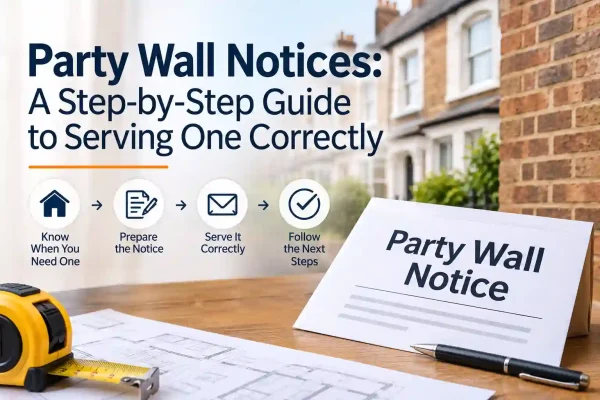
Planning an extension, converting your loft or carrying out structural work on your property? If the work involves a shared wall, a boundary or excavation close to your neighbour’s building, there is something you should check before your builders get started: do you need to serve a Party Wall Notice ?
It is easy to overlook this when you are busy arranging drawings, comparing building quotes and sorting out planning permission. You might even assume that telling your neighbour about the work is enough.
Unfortunately, it isn’t always that simple.
Under the Party Wall etc. Act 1996, certain types of building work require formal notice to be served on adjoining owners. Getting the notice wrong, sending it to the wrong person or overlooking the required notice period can create problems that delay your project.
So, what should you do before serving one? Let’s look at the process, the information you need and the mistakes worth avoiding.
Do You Need a Party Wall Notice for Your Building Work?
First, establish whether your proposed work falls within the Party Wall etc. Act 1996. Not every extension or home improvement project requires a notice. It depends on what you are doing and where the work will take place.
The Act generally covers three main situations:
Work to an existing party wall or structure (Section 3)
This can include:
- Cutting into a shared wall to insert a steel beam.
- Removing or altering part of a party wall.
- Raising or rebuilding an existing party wall.
- Cutting away projections from a party wall.
- Certain structural alterations involving a shared wall.
Building a new wall on or near the boundary (Section 1)
If you plan to build a new wall directly on the boundary line or wholly on your own land up to the boundary, you may need to serve a Line of Junction Notice.
Excavating close to a neighbouring property (Section 6)
This commonly affects homeowners planning extensions, basements or new foundations.
For example, excavation within three metres of a neighbouring building may fall under the Act if the proposed excavation goes below the level of its foundations. The six-metre rule can also apply where the excavation intersects a specified 45-degree plane extending downwards from the bottom of the neighbouring building’s foundations. Read More: 6 Questions to Ask Before Hiring a Party Wall Surveyor
The important thing is not to assume that your project is exempt simply because you are building on your own land. Some work can still affect your neighbour’s property and fall within the Act.

Which Party Wall Notice Do You Need? Understand the Three Types
This is where homeowners can easily become confused. There isn’t one universal Party Wall Notice that covers every type of building work.
The notice you need depends on the work being proposed.
| Notice type | When it is generally required | Notice period |
| Party Structure Notice | Work to an existing party wall or structure | 2 months |
| Line of Junction Notice | Building a new wall on or astride the boundary | 1 month |
| Notice of Adjacent Excavation | Qualifying excavation near a neighbouring building | 1 month |
These are the usual statutory notice periods. Starting earlier may be possible if the adjoining owner gives the required written agreement.
Choosing the correct notice is important. For example, if you are planning a loft conversion that involves inserting steel beams into a shared wall, a Party Structure Notice may be required. If your project also involves qualifying excavation for an extension, a separate excavation notice may be needed.
One project can therefore involve more than one notice.
What Information Should a Party Wall Notice Include?
A Party Wall Notice should give your neighbour a clear understanding of the work you intend to carry out.
It is not enough to write a short letter saying that builders will be working near the boundary next month.
The notice should contain the relevant details, including:
- The building owner’s name and address.
- The address of the property where the work will take place.
- A clear description of the proposed work.
- The intended starting date.
- Any additional plans, drawings or sections required for the particular type of notice.
For excavation work, plans and sections showing the location and depth of the proposed excavation, along with the proposed building’s position where applicable, must accompany the notice. Also Read: Before You Buy a House: Check These Party Wall and Boundary Issues
Pay attention to the description of the work. If you are proposing to remove part of a shared chimney breast, for example, the notice should explain the intended alteration rather than simply referring to general renovation work.
A downloaded template might provide a useful starting point, but it cannot establish whether you have selected the correct notice or included everything your particular project requires.

Who Should Receive the Notice and How Should You Serve It?
Another detail that can easily be overlooked is identifying the correct adjoining owner.
You should not automatically assume that the person living next door is the only person who needs to receive the notice. There may be more than one legal owner, and a neighbouring property could have separate ownership interests.
Take time to check the ownership details before serving anything. Where several adjoining owners are affected, each relevant owner must be notified.
There are also rules about how a notice can be served.
Generally, you can:
- Deliver it personally.
- Send it by post to the owner’s usual or last-known UK address.
- Send it electronically if the recipient has agreed to receive notices electronically, has not withdrawn that agreement and has provided the relevant email address.
Keep copies of the notices and any supporting documents. Record when and how they were sent, along with any responses received.
A clear paper trail can make a considerable difference if there is later a disagreement about whether the correct procedure was followed.
What Happens After You Serve a Party Wall Notice?
Once your neighbour receives the notice, they generally have three options: consent in writing, dissent in writing or take no action.
If they consent in writing, the relevant work can generally proceed once the applicable notice period has been dealt with, subject to any other legal requirements.
If they disagree, the Party Wall dispute resolution procedure may need to begin.
But what if they simply ignore the notice?
This is particularly important because silence does not automatically mean that your neighbour has agreed.
For work to an existing party wall and qualifying excavation, if the adjoining owner does not respond in writing within 14 days, a dispute is generally deemed to have arisen under the Act. Also Check: Party Wall Awards Explained Line-by-Line: What Property Owners and Neighbours Need to Know
The position is different for a new wall proposed astride the boundary. Without the adjoining owner’s written consent, you cannot build that wall astride the boundary. You may instead need to construct it entirely on your own land, following the applicable notice requirements.
This is why you should never assume that no reply means you can carry on with the original plans.

What If Your Neighbour Objects? When Do You Need a Party Wall Surveyor?
An objection does not necessarily mean your building project has to be abandoned.
It means the matter may need to be dealt with through the formal Party Wall procedure.
The owners can agree to appoint one Agreed Surveyor to act impartially for both sides. Alternatively, each owner can appoint their own Party Wall Surveyor.
The surveyors consider the proposed works and the relevant interests of both property owners. Where necessary, they prepare a Party Wall Award.
An Award is a formal document that can deal with matters such as:
- The nature and details of the authorised work.
- How and when the work can be carried out.
- Access arrangements where applicable.
- Protective measures for the adjoining property.
- A schedule of condition recording the property’s existing condition.
The surveyor’s role is not to decide whether your neighbour should like your extension or whether you deserve planning permission. It is to resolve matters falling within the Act and establish the necessary arrangements for the qualifying work. Also Check: Removing a Chimney Breast: Your Party Wall Obligations
Having the procedure dealt with properly can help both owners understand their respective rights and responsibilities before construction moves forward.
Common Party Wall Notice Mistakes That Can Cause Unnecessary Delays
Imagine your builders are booked, materials have been ordered and you are expecting work to start in a few weeks. Then you discover that the notice you sent was incorrect.
It is an avoidable situation, but it can happen.
Some common mistakes include:
- Using a Party Wall Notice template without checking whether it suits the proposed work.
- Sending the notice to the occupier rather than identifying the correct adjoining owner.
- Forgetting to notify another relevant owner.
- Giving only one month’s notice when two months are required.
- Failing to include the necessary excavation drawings.
- Assuming that planning permission replaces Party Wall requirements.
- Treating a neighbour’s silence as consent.
- Starting work before the statutory procedure has been properly followed.
One particularly important point: planning permission and Party Wall procedures are separate. Even if your extension has received planning permission, you may still need to comply with the Party Wall Act.
The best time to deal with these matters is during the planning stage, not when the contractors are already waiting to start.

Need Help With a Party Wall Notice? Speak to Faulkner Surveyors
Planning an extension, loft conversion or structural work? If you’re not sure whether the Party Wall Act applies to your project, it’s worth getting some advice before you start making arrangements with builders.
At Faulkner Surveyors, homeowners can seek professional assistance with understanding the Party Wall process and the requirements relevant to their proposed building work.
This can be particularly helpful if you:
- Are unsure which type of notice you need.
- Have several adjoining owners to notify.
- Are planning excavation close to neighbouring foundations.
- Need help understanding your neighbour’s response.
- Have received an objection and are unsure what happens next.
- Want professional assistance with the Party Wall procedure.
Rather than relying on a general online template and hoping everything is correct, you can get advice based on the actual work you intend to carry out.
The aim is straightforward: understand your responsibilities, follow the correct procedure and give your building project a better chance of progressing without avoidable Party Wall complications. See Here: Party Wall Issues for Flat Conversions: A Practical Guide for Property Owners
Planning building work? Contact Faulkner Surveyors before serving your notice so you can understand the requirements that apply to your project.
Frequently Asked Questions
Q: Can I serve a Party Wall Notice myself without appointing a surveyor?
Yes. A building owner can serve their own Party Wall Notice. However, you need to identify the correct notice, adjoining owners and statutory requirements. You do not automatically need a surveyor just to serve a notice.
Q: How much notice do I need to give my neighbour?
It depends on the proposed work. A Party Structure Notice generally requires two months’ notice, while a Line of Junction Notice and a qualifying excavation notice generally require one month’s notice. An earlier start may be agreed in writing where permitted.
Q: What happens if my neighbour ignores my Party Wall Notice?
For existing party wall work and qualifying excavation, failing to respond in writing within 14 days generally results in a deemed dispute. The surveyor procedure may then need to begin. New walls on the boundary have different rules, particularly where the proposal is to build astride the boundary.
Q: Can I send a Party Wall Notice by email?
You can send a Party Wall Notice by email if your neighbour has agreed to receive it this way and has provided an email address for receiving notices. They must not have withdrawn that permission. Otherwise, use an appropriate alternative method of service.
Q: Does every extension require a Party Wall Notice?
No. It depends on the design, location and type of work. An extension involving excavation close to a neighbour’s foundations or alterations to an existing party wall may require notice, but not every extension falls within the Act.
Q: Can my neighbour refuse a Party Wall Notice?
Your neighbour can dissent from the proposed work, but this does not automatically give them a right to prevent all qualifying work. The dispute resolution procedure can be used to deal with matters covered by the Act.
Q: Does planning permission mean I do not need a Party Wall Notice?
No. Planning permission and the Party Wall Act deal with different matters. Receiving planning permission does not remove your responsibility to serve notice where the Act applies.
Q: What should I do if I have already started building without serving a required notice?
Do not ignore the situation or assume that it will resolve itself. Seek professional advice promptly. An adjoining owner may be able to seek an injunction or other legal remedy, depending on the circumstances.
Q: How long does a Party Wall Notice remain valid?
A Party Structure Notice and relevant excavation notices generally cease to have effect if the work has not started within 12 months of service. Check the provisions applicable to your particular notice before relying on an older notice.
Q: Do I need a Party Wall Surveyor if my neighbour agrees to the work?
If your neighbour agrees to the proposed work in writing, you generally won’t need to appoint a Party Wall Surveyor. However, if you’re unsure whether you’ve served the correct notice or your planned work involves more complicated structural changes, speaking to a Party Wall Surveyor can help you avoid mistakes and make sure everything is in order before work begins.
For Further Information, Please Call Us Today: 03300100262